DISCIPLINE
7 Trading Rules for Momentum Traders: A Practical Checklist
Use measurable guardrails for risk, loss limits, size, concentration, and exits while keeping app-side checks separate from broker execution. The exact thresholds remain yours to choose.
BY TRADEREGIMEN EDITORIAL / PUBLISHED / UPDATED · 10 MIN READ
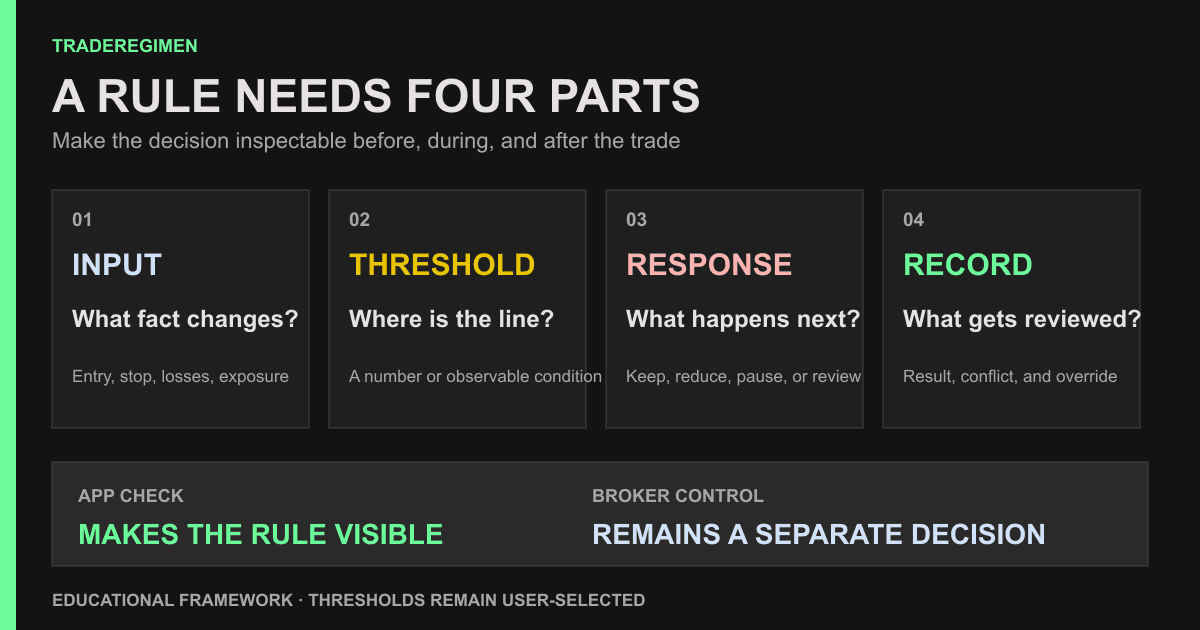
A note that says do not overtrade is easy to agree with and hard to evaluate at 11:00 a.m. A rule becomes useful when it can answer a live question: what input matters, where is the boundary, what happens when the boundary is reached, and what record will exist afterward?
The seven areas below are a checklist, not a universal parameter set. A trader still has to choose limits that fit the account, method, and risk tolerance. Software can make those choices visible. It cannot make them suitable or remove the possibility of loss.
The point of a rule is not to sound disciplined. It is to settle one decision before the position makes that decision feel urgent.
1. Define risk per trade before choosing shares
Start with the fraction of account equity that the plan permits at risk on one trade. Then choose the setup invalidation and calculate risk per share. A preferred share count should not pull the stop closer until the arithmetic happens to fit.
Raw shares = floor(dollar risk budget / absolute entry-to-stop distance)
That is only the first limit. Maximum position value, remaining portfolio risk, open slots, and a saved Market Context response can all reduce the final whole-share count. Use the smallest valid result. The portfolio-constrained sizing guide shows the complete sequence.
2. Define daily and weekly loss boundaries
Decide before the session what evidence will pause new entries. A daily rule may count positions that realized a full planned loss. A weekly rule may use cumulative R. These are different measurements and should not be collapsed into one vague instruction to stop after a bad run.
TradeRegimen's current Constitution supports a daily stop-out count and a weekly R boundary. The app can flag the saved boundary during a proposed manual entry. It does not close the brokerage app or prevent a new broker order. If a hard account control is needed, verify what the broker actually offers and how it behaves.
3. Record the invalidation before the entry
Write what would make the setup no longer qualify, the exact price reference, and whether an intraday trade or closing price counts. A planning stop, a close-based thesis rule, and a broker stop order are related but not identical.
The stop-first guide explains the tradeoff: a standard stop becomes a market order after its trigger and may fill worse than the stop price, while a stop-limit order may not fill at all. No order type guarantees the planned loss.
4. Decide what a Market Context conflict changes
A market label should not silently choose a multiplier. The current TradeRegimen rule evaluates the proposed long or short against the attributed model direction and the saved SPY/QQQ confirmation requirement. The response to a conflict can:
- show the conflict while keeping the base limits,
- limit risk and position value to half while allowing at most three counted risk positions, or
- return zero-share guidance and an in-app blocker for the new plan.
When context sizing is enabled, current Constitutions begin with one confirming index, neither index opposing, and the half-size conflict response. The user can review and change that rule. The breadth panel, sector leadership, and a 10-day breadth monitor do not secretly change the response. Read the Market Context guide for the evidence layers.
5. Check concentration, not just ticker count
Several positions can depend on the same sector, theme, index direction, or leveraged exposure. Counting ticker symbols will not reveal every shared risk. Review what would make the positions lose together and decide what level of overlap the Constitution permits.
TradeRegimen stores a Leveraged Sector Limit and renders that row in the position-entry checklist. The current manual request does not supply the proposed position's sector, however, so that row cannot currently evaluate sector overlap. Review concentration separately; do not treat the row as a complete model or order rejection.
6. Predefine position-management checkpoints
Before entry, record the scale-out tiers, stop reference, and the conditions that would make the original plan stale. Avoid treating one set of R milestones as universal; the appropriate structure depends on the method being tested.
For users with current Pro access and notifications enabled, TradeRegimen can surface scheduled alerts for supported stop zones, configured scale-outs, structural targets, and R milestones. It does not monitor every user-written exit sentence, submit an order, or guarantee that an alert arrives before the market moves.
7. Review exceptions separately from outcomes
A profitable trade can still contain an oversized entry or an ignored stop. A loss can occur after a well-structured plan. Record whether each rule was met, what was overridden, why the exception was accepted, and whether the same exception keeps recurring.
Review the rule on a planned cadence instead of rewriting it during a position. The goal is not to prove that the first threshold was correct; it is to leave enough evidence to decide whether the rule should stay, change, or be removed. The repeatable discipline workflow connects the pre-trade check with the later review.
Worked example: one rule stack, one share count
Consider a fictional DEMO long plan in a $50,000 account. The values illustrate the calculation; they are not a ticker, entry, stop, or size recommendation.
- Saved risk fraction: 0.50%, producing a $250 base risk unit.
- Planned entry: $50.00; planned stop: $47.50; risk per share: $2.50.
- Raw risk limit: 100 shares.
- Saved maximum position value: $4,000, producing an 80-share value limit.
- A Market Context conflict applies the saved half-size response.
Half of the base risk budget is $125, which allows 50 shares by risk. Half of the $4,000 position-value limit is $2,000, which allows 40 shares at the planned entry. Assuming portfolio risk and position slots still permit the trade, the final result is 40 shares because the value limit is tighter. A pause response, no remaining slot, or no remaining portfolio risk would make the result zero.
How TradeRegimen supports the checklist
In the current Pro manual-entry workflow, TradeRegimen renders six saved-rule rows: Market Context, daily loss, weekly loss, Leveraged Sector Limit, sizing, and exposure. The narrow correlation rule applies to leveraged positions in the same sector; when a proposed leveraged position lacks sector context, that row returns an unavailable warning instead of a false pass. The checklist shows conflicts and share guidance; where an override is available, the user remains responsible for accepting and recording it.
That workflow is decision support, not broker enforcement. Actual order entry, modification, cancellation, fills, and broker-native controls remain at the broker. For the broader onboarding path, continue to Start Here.
Sources and review context
- FINRA's stop-order overview explains trigger, execution-price, and stop-limit risks.
- FINRA's concentration-risk guide explains why holdings that look separate can still share a risk driver.
- FINRA's risk-tolerance guide supports choosing limits from the investor's own time horizon, objectives, reliance on the funds, and tolerance for loss.
- Product behavior and access boundaries were reviewed against the current Constitution, sizing, entry-check, coaching, alert, and broker implementations on September 14, 2026. See the editorial policy for the correction process.
This material is educational and informational, not individualized investment advice. Read the full product and market-data disclaimer.
FREQUENTLY ASKED
What makes a trading rule usable?
A usable rule names the input, the threshold or condition, the response, and the moment it will be reviewed. 'Manage risk' is an intention. 'Use the planned entry and stop to calculate shares, then cap the result at the saved risk and position-value limits' can be checked.
Does TradeRegimen block a brokerage order when a rule conflicts?
No. In its position-entry workflow, TradeRegimen can show a conflict, return sizing guidance, and record an acknowledged exception. It does not place, block, cancel, or manage brokerage orders.
Should every momentum trader use the same risk percentages and loss limits?
No. Account structure, experience, strategy, holding period, financial situation, and risk tolerance differ. The useful discipline is choosing a supported rule before the trade and reviewing the outcome, not copying a universal percentage from an article.
Run your trading like a system.
Build your Constitution, check a manual position plan when you log it, and review rule states while recorded positions are open.
Get Started