DISCIPLINE
How to Improve Trading Discipline With a Repeatable Process
A trading plan is useful only when it is specific, visible, and reviewable at the moment you have to make a decision. Here is a practical loop for turning written intentions into a process you can inspect.
BY TRADEREGIMEN EDITORIAL / PUBLISHED / UPDATED · 9 MIN READ
You can write a careful plan on Sunday and still ignore it on Tuesday. The problem is often not that the rule disappeared from memory. The problem is that the rule never became part of the live decision.
A note that says manage risk cannot tell you whether 180 shares are too many. A promise to avoid revenge trading cannot tell you whether the next order would cross your daily loss limit. The useful version of a trading rule has an input, a threshold, and a moment when it is checked.
Trading discipline is easier to inspect when each decision leaves a record: the rule, the proposed action, the conflict, and what you chose.
Start with rules that can answer a real question
Broad principles still matter, but they need an operational form. For example, “keep losses small” becomes several separate decisions:
- How much account equity may be at risk on one trade?
- What price invalidates the setup?
- How many shares fit both that stop and the position-value cap?
- When should new entries pause after daily or weekly losses?
- How much correlated exposure is already open?
TradeRegimen calls this structured rule set a Trading Constitution. The name matters less than the structure: your limits should be concrete enough to evaluate before you send an order.
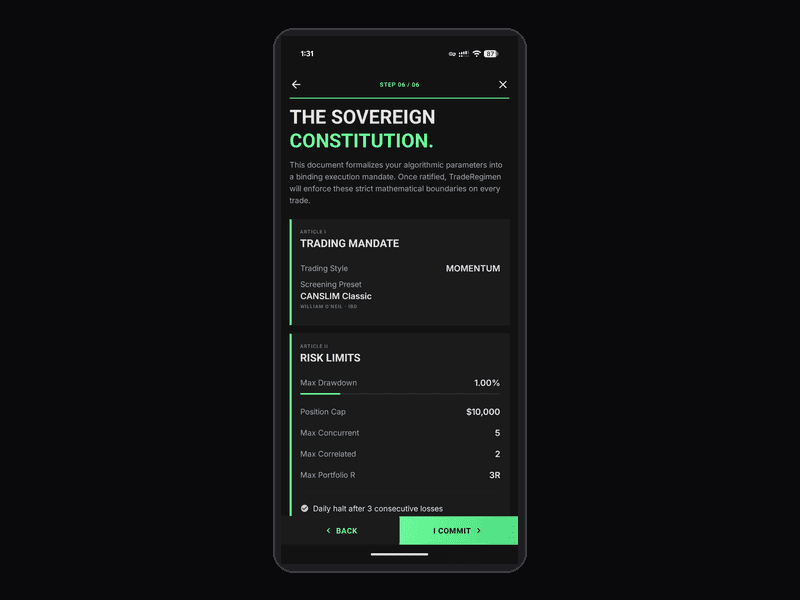
The five-part discipline loop
1. Define the rule before the market creates urgency
Write the rule while no position is demanding an answer. Set the risk limit, position cap, loss limits, correlation limit, acceptable setup types, and planned scale-out structure. If you need a worksheet, use the step-by-step Constitution guide, or use the seven-rule checklist to turn broad intentions into testable inputs, boundaries, and responses.
2. Separate market context from the trade decision
Market conditions can affect the amount of risk you are willing to take, but a market label is not an instruction to buy or sell. Read the model, index action, breadth, and sector or theme context as separate facts. Then apply the sizing rule you already saved for that environment.
3. Choose the invalidation point before calculating shares
Do not choose a comfortable share count and force the stop to make the arithmetic work. Decide what price would invalidate the setup, calculate risk per share, and then let the tightest portfolio rule limit the size. The stop-first guide works through that sequence in detail.
Consider a fictional $50,000 account with a 0.5% per-trade risk limit. The dollar risk budget is $250. If a hypothetical entry is $50 and the planned stop is $47.50, risk per share is $2.50, which produces a raw limit of 100 shares. If the Constitution also caps one position at $4,000, that second rule lowers the limit to 80 shares. Correlation, total exposure, or a saved Market Context rule could lower it again.
This example explains the calculation; it does not recommend a ticker, entry, stop, or position size.
4. Check the proposal, including the uncomfortable parts
During manual position entry, TradeRegimen evaluates six areas against the saved Constitution: Market Context, daily loss, weekly loss, correlation, sizing, and exposure. A conflict is information at the decision point. You can revise the plan or, where the workflow permits, acknowledge an override. The app does not place or block the brokerage order.
5. Review the decision separately from the result
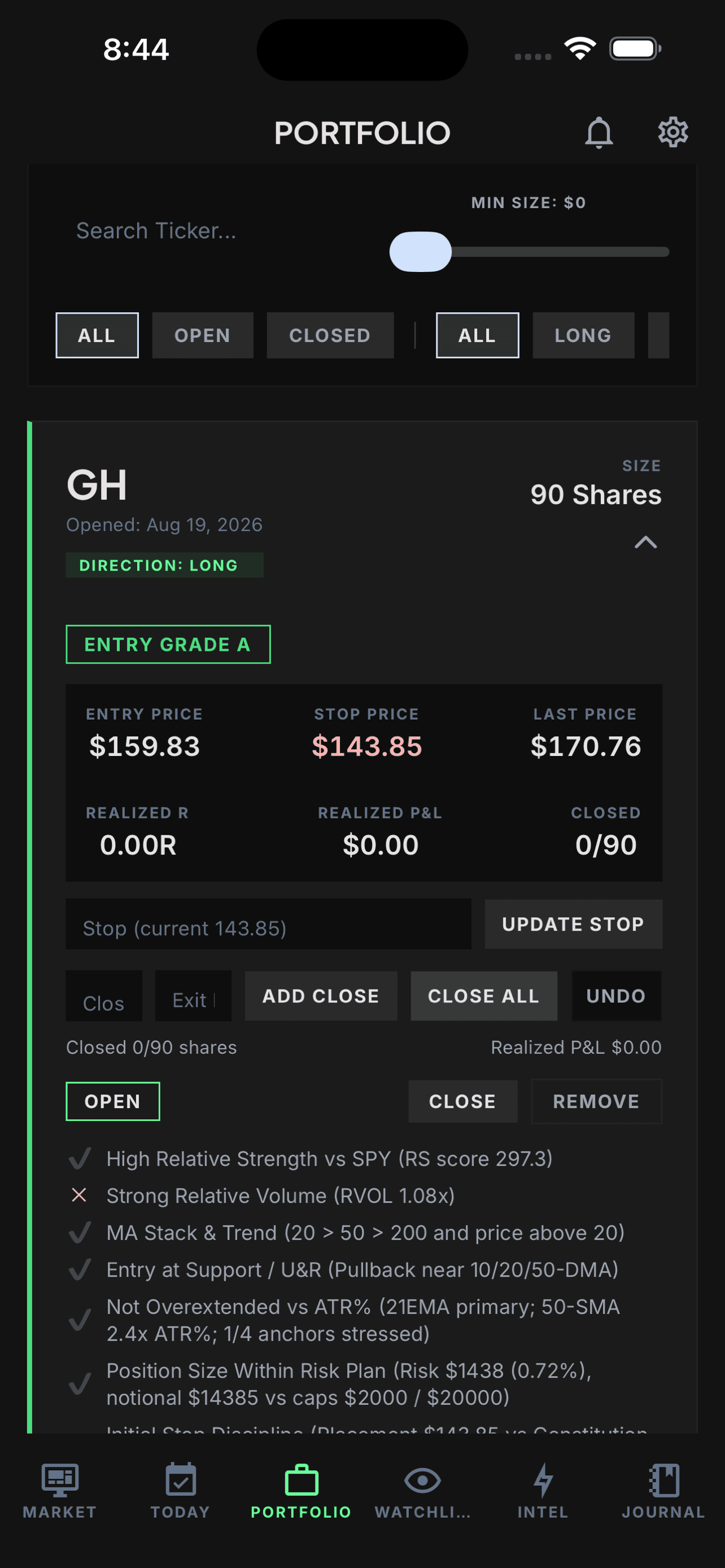
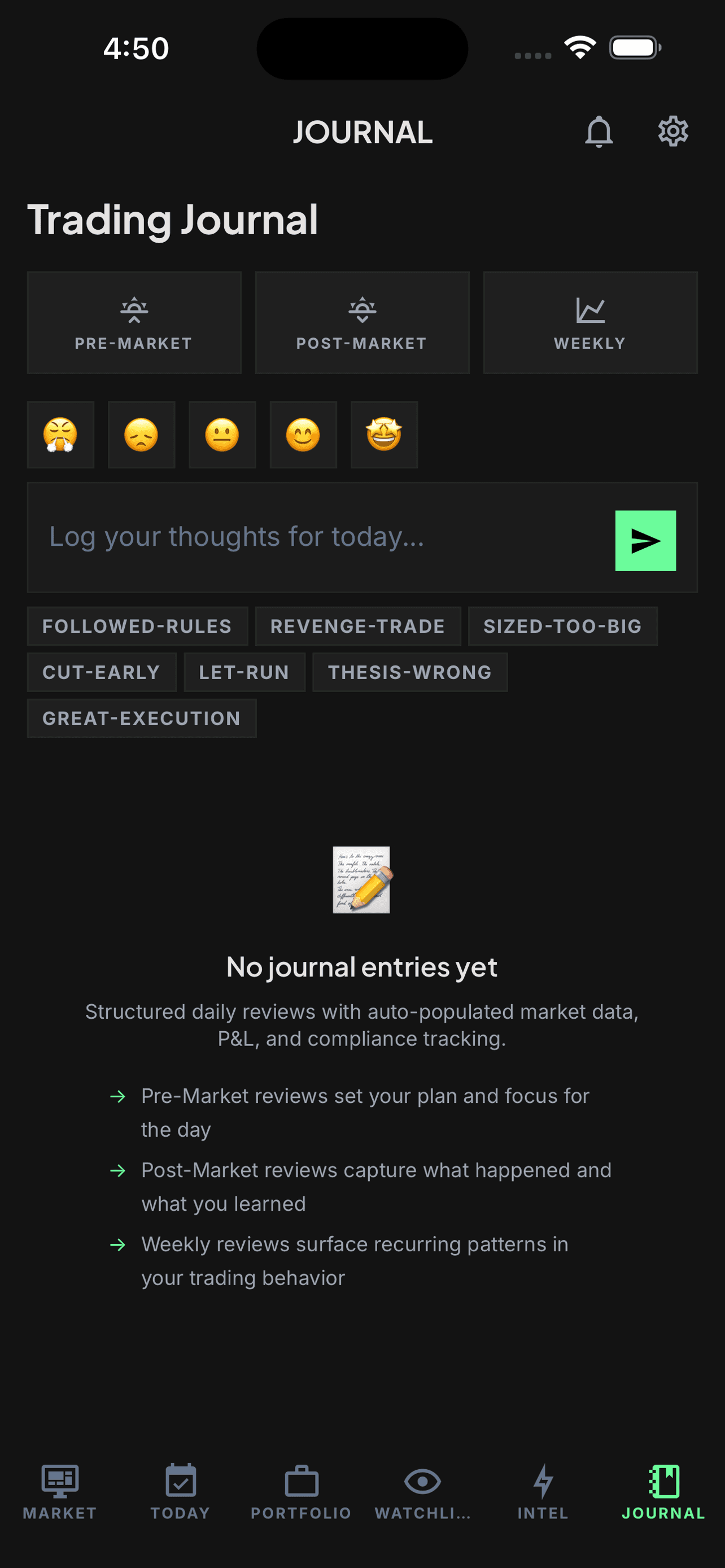
A profitable trade can contain a poor sizing decision. A losing trade can follow the plan exactly. Review both columns: what happened to the position, and whether the process matched the rules that existed before entry. Record the reason for overrides and rule changes in your journal notes; do not rewrite your entry notes to make the outcome look inevitable.
What usually breaks the loop
- The rule is vague. “Do not oversize” still leaves the live decision open. Define the percentage, dollar cap, or formula.
- The rule changes after entry. New evidence can justify a new plan, but discomfort alone should not silently rewrite the invalidation point.
- One green check becomes permission. Passing a size check does not prove the setup is good, and favorable Market Context does not predict the next move.
- An override loses its context. TradeRegimen records the failed checks and acknowledgment, but not a free-text rationale in the pre-trade modal. Add the reason to your journal notes if you want that context available during a later review.
- The data is stale. Check timestamps and broker coverage before treating a displayed position or market fact as current.
Where TradeRegimen fits
TradeRegimen keeps the user's saved rules, current context, proposed trade, open-position state, and later review in one workflow. That can reduce the number of decisions made from memory alone. It cannot decide whether a trade is right, guarantee that a rule is well designed, or control an order at the broker.
Constitution setup and the core Market Context summary are available on Free. Deeper market analysis, position tracking, pre-trade checks, Position Coaching, and Journal require Pro access. Review the current pricing and intro offer before starting those workflows.
Use broker-native stop and limit orders when they fit your plan and broker. Use TradeRegimen to make the surrounding decision process visible and reviewable. Market, broker, and third-party data can be delayed, incomplete, or wrong, so verify critical information before acting.
Your next step
Do not rewrite your entire trading process today. Pick one recurring decision, make the rule measurable, and decide where it will be checked. Then follow the TradeRegimen Start Here path to connect that rule to the rest of the workflow.
REVIEW NOTE
Updated September 7, 2026 against the current TradeRegimen product workflow. Screens use seeded or illustrative demo data. Educational information only, not individualized investment advice. TradeRegimen is currently available only to users in the United States. Read the full disclaimer.
FREQUENTLY ASKED
What does trading discipline mean in practice?
Trading discipline means defining a repeatable decision process before the trade, checking the proposed trade against that process, and reviewing any deviation afterward. It is more useful to track specific actions such as position size, stop placement, and rule overrides than to label yourself disciplined or undisciplined.
How can I improve my trading discipline?
Start with a small set of measurable rules, keep them visible at the moment of entry, use broker-native controls for actual orders when appropriate, and review exceptions without rewriting the rules during the trade. The goal is a process you can inspect, not a promise that every decision will be correct.
Does TradeRegimen block trades that break my rules?
No. TradeRegimen checks a proposed manual entry against the user's saved Constitution and displays conflicts, sizing guidance, and override context. It does not place, block, or manage brokerage orders. The user remains responsible for every decision and order.
What should I review after a trade?
Review the plan that existed before entry, the actual size and stop, any rule conflict or override, how the position was managed, and whether the outcome changed your judgment of the process. A profitable result does not automatically make the entry well structured, and a loss does not automatically make the process wrong.
Run your trading like a system.
Build your Constitution, check a manual position plan when you log it, and review rule states while recorded positions are open.
Get Started