RISK MANAGEMENT
How Portfolio Risk Limits Position Size
A trade can fit its standalone risk-per-share calculation and still be too large for the portfolio. After you choose an entry and stop, use the smallest whole-share count allowed by the effective risk budget, position-value cap, remaining portfolio R, open slots, and your saved Market Context response.
BY TRADEREGIMEN EDITORIAL / PUBLISHED / UPDATED · 9 MIN READ
A single-trade calculator can say 200 shares while the portfolio has room for only 40. Both numbers can be mathematically correct. They are answering different questions.
The useful question is: how many whole shares fit the trade risk and the portfolio rules that apply right now? For U.S. stock shares, calculate every relevant limit and use the smallest valid share count. This method does not cover fractional shares, options, or futures.
The position sizing formula
Risk per share = |entry - stop|

Base 1R dollars = equity x risk-per-trade fraction

Per-trade budget = base 1R dollars x Market Context multiplier x optional grade multiplier

Remaining portfolio risk = max(0, (maximum portfolio R - current portfolio R) x base 1R dollars)

Effective risk budget = min(per-trade budget, remaining portfolio risk)

Shares by risk = floor(effective risk budget / risk per share)

Shares by position value = floor((maximum position value x Market Context multiplier x optional grade multiplier) / entry)

Final shares = min(shares by risk, shares by position value)
The result is zero before those last two values are compared when the Market Context rule pauses new positions, every permitted position slot is occupied, or no portfolio risk remains. A valid calculation can also round down to zero when either budget cannot buy one whole share.
The smallest valid limit sets the size. It is normal for the same entry and stop to produce a different answer as the portfolio changes.
Choose the stop before you calculate shares
Position sizing begins after the setup has a planned entry and an invalidation price. Do not move the stop closer merely to preserve a preferred share count. If that part of the plan is unfinished, use the stop-first guide before this formula.
For a long stock plan, the stop must be below the entry. For a short stock plan, it must be above the entry. The absolute distance between them is the planned risk per share.
The constraints that actually set the share count
- Risk per trade: account equity multiplied by the risk fraction saved in the Trading Constitution. This unadjusted dollar amount is one base risk unit, or 1R.
- Remaining portfolio R: the unused portion of the total portfolio-risk allowance, converted back to dollars with the base 1R amount.
- Maximum position value: the largest permitted entry-price value for one position.
- Open position slots: the number of new positions still permitted by the current rules.
- Market Context response: the user's saved action when the proposed direction conflicts with the model direction or the selected SPY/QQQ tape-confirmation requirement.
In TradeRegimen's graded setup flow, an Entry Grade can also reduce the risk and position-value allowances. Manual position entry does not infer a grade, so its grade multiplier remains 1.00.
Market Context is a saved rule, not a market command
A bullish, neutral, or bearish label does not automatically choose a multiplier. The Market Context rule compares the proposed direction with the model direction and the SPY/QQQ tape-confirmation requirement the user selected. When the rule is met, the base limits remain. When it conflicts, the saved response can flag the conflict without reducing size, cap risk and position value at half while allowing at most three positions, or pause new positions.
Read the Market Context guide to see how the model, tape, breadth, and leadership layers stay separate before this sizing rule is evaluated.
That distinction matters. “Neutral market means half size” is not the product rule. Half size is one explicit response the user can apply to a direction-aware conflict.
Worked example: the same trade in two portfolio states
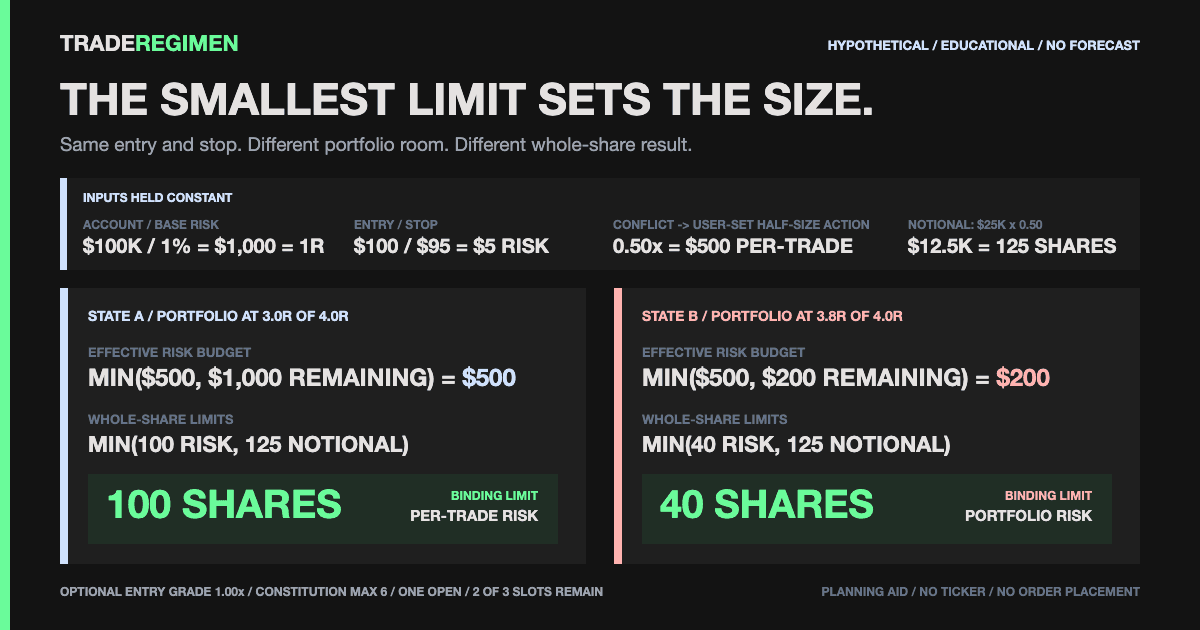
This is a fictional long-stock example, not a security recommendation. Hold every input constant except current portfolio R:
- $100,000 account equity and 1% base risk, so 1R is $1,000.
- $100 planned entry and $95 planned stop, so risk per share is $5.
- $25,000 maximum position value, 4R maximum portfolio risk, and six positions permitted by the base Constitution.
- A Market Context conflict with the saved half-size action, so the effective trade budget is $500, the effective position-value cap is $12,500, and no more than three positions are permitted.
- One position is already open, leaving two slots. The optional Entry Grade multiplier is 1.00.
| State | Risk room | Risk shares | Value shares | Final | Binding rule |
|---|---|---|---|---|---|
| A: 3.0R of 4.0R used | $1,000 | 100 | 125 | 100 | Per-trade risk |
| B: 3.8R of 4.0R used | $200 | 40 | 125 | 40 | Portfolio risk |
In State A, the smaller of the $500 trade allowance and $1,000 of remaining portfolio room is $500. That buys 100 shares by risk, while the $12,500 position-value cap permits 125. The final size is 100 shares, adding 0.5R and taking the portfolio to 3.5R.
In State B, only $200 remains before the 4R portfolio ceiling. That buys 40 shares and becomes the binding rule. The plan reaches 4R after adding the position.
What current portfolio R means here
TradeRegimen calculates open portfolio risk from the recorded entry, the initial stop when available (otherwise the recorded stop), and the remaining shares of each risk position. It then divides that total by the current base 1R amount. Partial closes reduce the remaining quantity. This is a planning measure based on recorded inputs, not live mark-to-market loss potential and not a guarantee of the price at which a broker order will execute.
Copyable position-sizing worksheet
Direction:
Entry:
Stop:
Risk per share = |entry - stop|:

Account equity:
Risk per trade (%):
Base 1R dollars = equity x risk fraction:

Current portfolio R:
Maximum portfolio R:
Remaining portfolio risk dollars:

Market Context state and saved response:
Market Context multiplier:
Optional Entry Grade multiplier (1.00 if none supplied):

Per-trade budget after multipliers:
Effective risk budget:
Maximum position value after multipliers:

Shares allowed by risk (round down):
Shares allowed by position value (round down):
Open positions / permitted positions:

Final whole shares:
Binding rule:
If the final line surprises you, do not change the stop just to make the number larger. Find the input or rule that produced the result and decide whether the plan still makes sense.
What the share formula does not check
Daily and weekly loss limits are separate pre-trade checks. Concentration and correlation also need their own review; this formula does not estimate how positions may behave together. A share count can fit the calculation and still conflict with the broader trade plan. That is why “the size fits” and “the complete plan fits every rule” are different statements.
How TradeRegimen shows the calculation
The user enters direction, entry, and stop. TradeRegimen combines those inputs with saved Constitution limits, open portfolio risk, available slots, and the applicable Market Context response. The ticket shows calculated whole shares, risk per share, dollar risk, risk percentage, position value, projected portfolio R, open slots, and the rule that limited the result.
In manual position entry, the user can acknowledge and record an overage, then optionally add the rationale to a linked journal entry. A graded setup sheet clamps its quantity control at the calculated amount. Neither workflow places, blocks, cancels, or manages an order at the broker. The trader owns the setup, inputs, decision, and order.
Where the shortcut can fail
- A poor stop produces precise-looking nonsense. The formula measures distance; it cannot decide whether the setup is actually invalid at that price.
- Recorded portfolio data can be stale or incomplete. Reconcile open positions and remaining quantities before trusting the available R and slot counts.
- Market inputs have freshness limits. Review the displayed state and timestamps. Third-party data can be delayed, incomplete, or wrong.
- Planned risk is not guaranteed realized risk. A gap, fast market, liquidity, and broker-order mechanics can produce an exit away from the stop price.
- Rounding up breaks the limit. Use whole shares and round down at each final share constraint.
- Hidden concentration still matters. Several highly correlated positions can behave like one large exposure even when each position passes its standalone size calculation.
Run one plan through the stack
Take one hypothetical trade and complete the worksheet. Circle the binding rule. If the result is zero, write down why before changing anything. If you still need to define the limits themselves, start with the TradeRegimen workflow guide.
Sources and review context
This guide was substantively reviewed against the TradeRegimen position-sizing engine, Market Context rules, current portfolio-risk calculation, and position-entry workflows on September 14, 2026.
- FINRA: Stop Orders - Factors to Consider During Volatile Markets (March 26, 2025; accessed September 14, 2026) explains why a stop price does not guarantee the execution price.
- FINRA: Concentrate on Concentration Risk (June 15, 2022; accessed September 14, 2026) explains how correlated holdings can create concentration that is not obvious from separate position labels.
- Read the TradeRegimen editorial methodology and full educational-use disclaimer.
Scope of this method
The example is hypothetical and for educational planning only. Verify the inputs and arithmetic independently. TradeRegimen is not registered as an investment adviser or broker-dealer. Its calculations are for informational and educational purposes and do not constitute a recommendation to buy, sell, hold, or otherwise trade any security or financial instrument.
Run your trading like a system.
Build your Constitution, check a manual position plan when you log it, and review rule states while recorded positions are open.
Get Started