METHODOLOGY
When Is a Trading Setup Still Valid?
A screening match, an actionable entry plan, and a tracked outcome are different things. A useful lifecycle says which one you are looking at, what changed, and how fresh the evidence is.
BY TRADEREGIMEN EDITORIAL / PUBLISHED / UPDATED · 8 MIN READ
A stock can still match a screening preset after its saved entry plan has become too old, too extended, or structurally broken. It can also trade above a trigger during the day before the scheduled outcome record has processed that day's close. Treating all three facts as the same status turns a useful scan into false precision.
A screening match finds a candidate. An actionability check tests the saved plan. An outcome record says what happened later.
Separate the three layers
- Screening match: The ticker met the active preset's rules when its candidate snapshot was evaluated.
- Entry plan: A frozen trigger, entry zone, stop, and target ladder survived the current actionability checks.
- Outcome record: Scheduled daily-bar tracking records whether a close reached the trigger, a target, or the stop.
The distinction matters after any scan, including a Volatility Contraction Pattern review. Pattern evidence explains why the candidate appeared. It does not keep yesterday's entry plan current forever.
What Active, Triggered, and Invalidated mean
Active
The stored signal is Active and its outcome is still Tracking or has not been created. On the main Today shortlist, Setup Analysis is attached only when the available quote also passes the plan-structure, age, stop, target, and extension checks. Active is not a forecast, and it does not necessarily mean price is inside the entry zone.
Triggered
The scheduled nightly outcome tracker uses daily closes. It marks the setup Triggered when a stored daily close is at or above the scan trigger. T1, T2, and T3 outcome states remain grouped under the public Triggered label. This is not an intraday alert or an instruction to enter, and a Triggered outcome alone does not make the plan non-actionable in the current entry check.
Invalidated
Invalidated is the public terminal bucket. It includes a stopped-out, invalidated, or expired outcome. When no higher-priority Triggered or target-hit outcome exists, a stored signal marked Invalidated or Expired also maps here. The label can mean that risk broke, or simply that the original plan became too old or extended. It does not prove that every part of the original pattern thesis was wrong.
The current entry-actionability rules
The following rules describe the TradeRegimen implementation reviewed on September 16, 2026. They are operational defaults, not universal trading rules.
- Plan integrity: The trigger must be finite and positive. The stop must be finite, positive, and below the trigger. Any populated long targets must rise strictly from the trigger, and a missing target cannot be followed by a later one.
- Recorded outcome: Stopped-out and invalidated outcomes invalidate the entry plan. An expired outcome or any recorded target hit removes it from the fresh-entry surface.
- Age: The plan expires after more than 15 weekday-counted trading days. It remains inside this rule through day 15 and expires on day 16. The counter excludes Saturdays and Sundays; it does not separately model exchange holidays.
- Lower price: An available quote more than 5% below the trigger invalidates the plan. A quote at or below the stored stop also invalidates it.
- Target proximity: A quote at or above 99.5% of any stored target, which is within 0.5% of that target, expires the plan for a fresh entry.
- Upper extension: A quote more than 3% above the entry-zone ceiling, or more than 8% above the trigger, expires the original entry plan.
The boundaries are literal. Exactly 5% below the trigger does not fail the first lower-price rule, although the stop rule may still apply. Exactly 3% above the entry-zone ceiling and exactly 8% above the trigger do not fail their respective extension rules. The target-proximity rule is inclusive. Several rules can overlap, and the evaluator reports the first one it encounters.
A fictional $100 setup through all three states
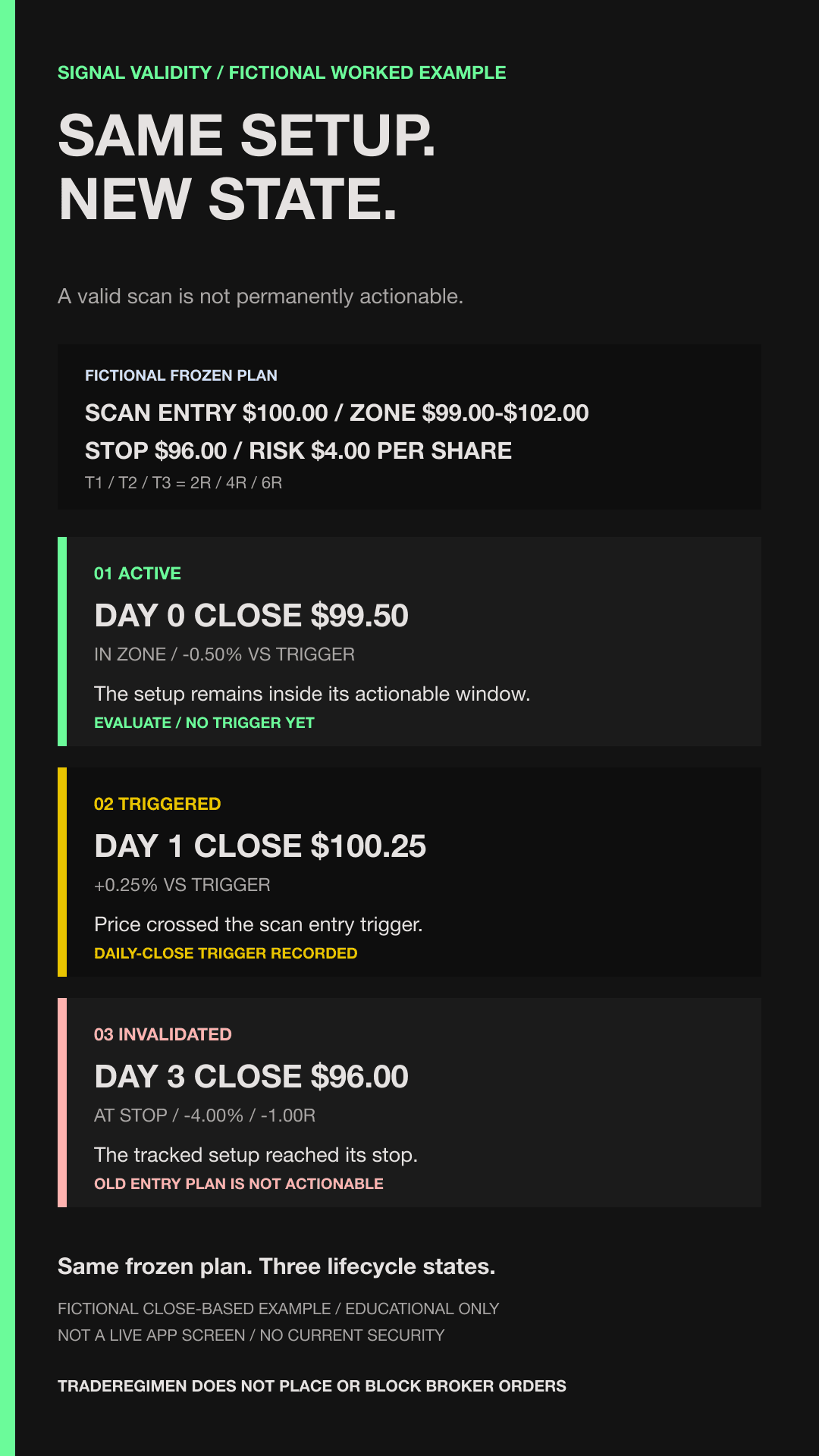
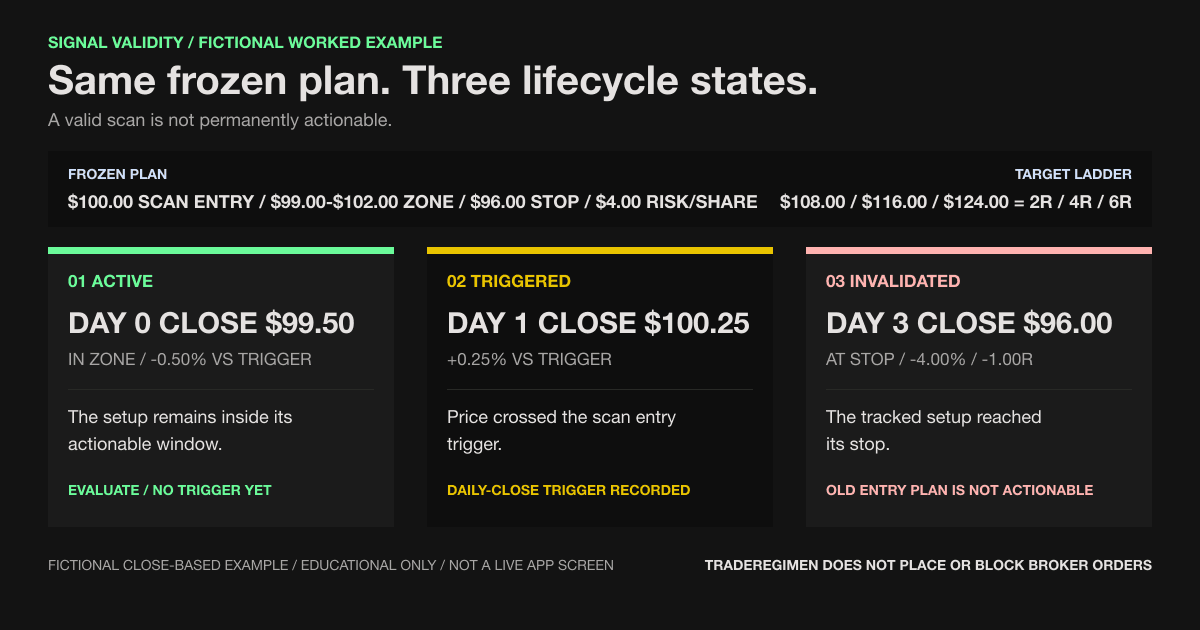
Consider a fictional symbol named DEMO. Its saved plan has a $100 trigger, a $99-$102 entry zone, a $96 stop, and targets at $108, $116, and $124. No real security or historical result is represented here.
1. Active at $99.50
The fictional starting close and review quote are both $99.50, the setup is only a few weekdays old, and its outcome is still Tracking. The price is below the trigger but above the stop and the 5%-below-trigger boundary. The plan is Active. Notice that Active describes the saved setup; it does not say the trader should enter.
2. Triggered after a $100.25 daily close
A later stored daily bar closes at $100.25. The scheduled outcome update records that close at or above the $100 trigger and changes the public state to Triggered. An intraday print above $100 would not, by itself, prove that the nightly outcome record had changed.
3. Invalidated after a $96 daily close
After the trigger, a later daily bar closes at $96. The outcome tracker records the stop as reached, and the public state becomes Invalidated. Separately, an available $96 quote also fails the live entry check because it is at the stop.
The same fictional plan would also be retired for a new entry above $105.06, which is 3% above the $102 entry-zone ceiling; above $108, which is 8% above the trigger; at or above $107.46, which is 99.5% of the $108 T1; below $95, which is more than 5% below the trigger; or after the fifteenth counted weekday. These conditions overlap. The first matching reason determines the transition recorded by the entry check.
Freshness is part of the state
The Today workflow combines data that refreshes on different clocks. System-preset candidate snapshots are scheduled each day at 4:30 a.m. Eastern Time, with an on-request evaluation when a usable same-day snapshot is missing. User overrides are evaluated lazily. The response carries the snapshot time, but the current Today screen does not display that top-level value.
The server separately requests an Alpaca stock snapshot and uses its latest-trade price for the entry-actionability check. The response does not carry that quote's timestamp into the current setup card. The shortlist card's visible price comes from the screening snapshot, while Setup Analysis can show the request-time quote. Those values do not necessarily share an as-of time.
The Today shortlist response can be cached on the device for up to five minutes. Pull to refresh bypasses that cache. The scheduled nightly outcome tracker uses daily closes, so Triggered, target, and stop states can also lag an intraday move. A badge is a compact state summary, not a substitute for checking the data behind the next decision.
Outcome research has a separate, longer horizon. An untriggered Tracking outcome expires at 60 weekday-counted days, with an approximate 90-calendar-day safety sweep for old rows when bar replay has not closed them. That longer record does not extend the 15-day entry window.
What happens when data or a plan is missing
A screening match can remain visible without a full plan. If the main Today request cannot obtain a current quote, it returns the candidate as a lean Match row and withholds Setup Analysis for that cached plan. A separate read of an already stored active signal can still leave it Active with no current price. That is why Active should never be read as proof of a fresh quote across every screen.
The Today screen currently shows a lifecycle badge and reason on each materialized setup card. It does not show a complete lifecycle-history panel. Price-based terminal reasons are not presented as a permanent on-screen audit trail after the card leaves the fresh-entry shortlist.
On the server, an identical plan from the same or an older snapshot cannot recreate a terminal signal. A genuinely newer snapshot can create a new plan from newer evidence. An already cached client response may still remain visible until refresh or cache expiry, so this is a plan-version guard rather than a promise of instantaneous UI removal.
How the TradeRegimen workflow uses the state
- The active preset produces a screening Match.
- A valid plan and available quote produce a setup card with a lifecycle badge and reason.
- View Setup Analysis shows the frozen trigger, zone, stop, and targets alongside the available current price.
- Review & Log Shares runs the pre-trade rule check before the user chooses whether to record a position.
TradeRegimen reports rule conflicts and records the user's decision. It does not place, block, cancel, or manage brokerage orders. For the earlier planning steps, use a dated watchlist workflow to keep candidates reviewable, then define the invalidation before calculating shares.
Review one plan now
For one saved setup, write down the trigger, stop, entry-zone ceiling, maximum age, and evidence timestamp. Then label it Active, Triggered, or Invalidated without using the eventual profit or loss to rewrite the original plan. The TradeRegimen Start Here workflow shows how that state fits between market context, pre-trade risk, and review.
FREQUENTLY ASKED
What does Active mean in TradeRegimen?
Active means the stored setup is still waiting and passes the applicable actionability checks. It is not a forecast, recommendation, or guarantee that the latest price is inside the entry zone. When a current quote is available, TradeRegimen also checks the plan's stop, targets, age, and extension before attaching Setup Analysis on the Today shortlist.
When does TradeRegimen mark a setup Triggered?
The scheduled outcome tracker marks a setup Triggered after a stored daily close is at or above the scan trigger. This is not an intraday crossing alert. Public lifecycle status also keeps T1, T2, and T3 outcome states in the Triggered group.
When does TradeRegimen retire a setup from a fresh-entry surface?
Current entry rules retire a setup after more than 15 weekday-counted days, when an available quote is more than 5% below its trigger, at or below its stop, more than 3% above its entry-zone ceiling, more than 8% above its trigger, or within 0.5% of a stored target. Terminal outcome states and malformed plans are also rejected. These are current product defaults, not universal trading rules.
What happens when a current quote is unavailable?
The main Today shortlist can preserve the screening match but withhold the Setup Analysis plan and its entry workflow. An already stored active signal can remain Active on a separate existing-signal read with its current price unavailable, so the badge alone is not proof of a fresh quote.
Does Triggered mean I should buy?
No. Triggered records what happened relative to a saved trigger. It does not decide whether the current price, portfolio risk, or trader's rules support a new entry. TradeRegimen reports rule conflicts and records the user's decision; it does not place, block, cancel, or manage brokerage orders.
How fresh is a signal-validity state?
The candidate snapshot, request-time quote, and scheduled daily-bar outcome can have different timestamps. The Today response can be cached on the device for up to five minutes, and the current screen does not display a per-price quote timestamp. Pull to refresh before using the state as an input to a new decision.
Run your trading like a system.
Build your Constitution, check a manual position plan when you log it, and review rule states while recorded positions are open.
Get Started